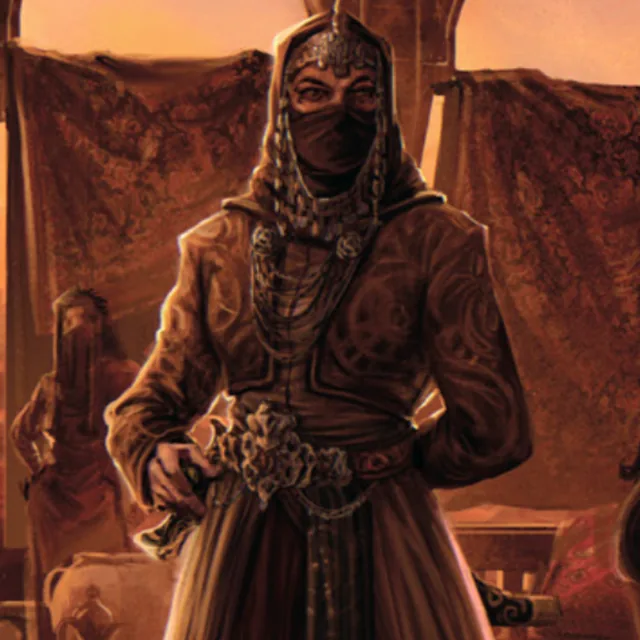
Ahra "the Wolf" is a woman of sturdy build who goes clad in the unmistakable dress of the Janissaries, and she stands foremost among them — the living remnant of a military order that was once the terror and the glory of the Ottoman Empire. Her name travels ahead of her, attended by a strong presence and by a fixed purpose: to restore the corps to its former splendour, and to shelter the common people of the Empire from those who would prey upon them. With Osman Hamdi Bey she keeps a formal understanding, the sealed letters that pass between them marking a correspondence of long standing.
When the company first came before her, she acknowledged Osman's letter and professed herself willing to aid them in the recovery of his stolen journal — though her goodwill did not come unpriced. She would have compensation, and she set them to work their way into the city's several criminal houses, that they might name its great figures, Giannis "the Cut", Hano "the Widow", and Chique Manu among them. In all this she was direct and unsentimental, leaving no doubt of the gravity of the errand or of the perils attending it.
Though she is not often to be found in person, her hand is felt throughout the Janissaries. Her judgement of men and of moments is famously keen, nowhere more than in the measuring of her recruits; and Hano "the Widow," who serves under her, is forever repeating her mistress's verdict upon this or that newcomer — a small proof of the authority she commands within the order.
The corps met no light trial when they fell in with an albasti, one of those creatures that feed upon the dreams of the sleeping. They faced it down with spirit and no little ingenuity, and bore its carcass to Hano "the Widow," who received their work with warm approval and relayed Ahra's own good opinion of their late efforts — confirming her once more as the overseer of the order's monster-hunting, and a leader jealous of her people's safety and strength.
Ahra "the Wolf" carries weight, besides, in the political and social currents of the city. Bound closely to Osman Hamdi Bey, she has thrown herself into the matter of the recent unrest, and stands watchful over the fallout of its violences — among them the deeds of the Ghost of March, who is held to have had a hand in the death of Nazif, a perfumist.
In one audience she owned the turmoil freely and confirmed that she knew of the Ghost of March's doings. She laid upon the company the task of putting down the undead at Saint Benoit Church as their payment for a recovered journal, and spoke with concern of the several state armouries lately broken into, and with a wry respect of a protest that had shown courage without touching her own people. She could tell them, too, of the searched lodging of an outspoken agitator — a mark of how nearly she watches both the safety of the streets and the intrigues that run beneath them. Naming the undead that troubled Saint Benoit by the word meftun, she counselled the party upon the undercity's passages, and showed her wide acquaintance with the city's tangled ways.
Of late the walking dead have weighed upon her more and more. She thanked the party for setting to rights the trouble of the undead at a place of her concern, and told them she had returned the journal to Osman, who now wished to speak with them; she gave them leave to keep or sell the spoils gathered in their expedition, pressing all the while for a swift end to the affair, and standing as the ready go-between of the party and Osman.
Beyond these labours she works toward a common front with Alemdar Mustafa Pasha, the master of the Ghosts. Alemdar owns the old ill-feeling between them and seeks a reconciliation, which marks her standing in the present order of things; yet there is some question of her view upon admitting the fuller variety of humankind to the Empire's defence — a thing Alemdar would have broadened. She is joined, too, to the recent business of the weapons-caches struck at about the time of the Festival of Candles, and so to the wider conflicts stirring within the Empire.
In the latest turn it has come out that an assassin known as Ahra 'the Wolf', of the Janissaries, is charged with the killing of Alexander's wife, Nadia, for her use of magic — a deed that has raised a blood-feud against her, Alexander seeking his revenge. Meeting the party in the catacombs, he told them of his past with Ahra 'the Wolf', spoke his anger and his hunger for retribution, and warned them of her deadliness — a fitting caution amid the perilous currents that gather about her and her order.