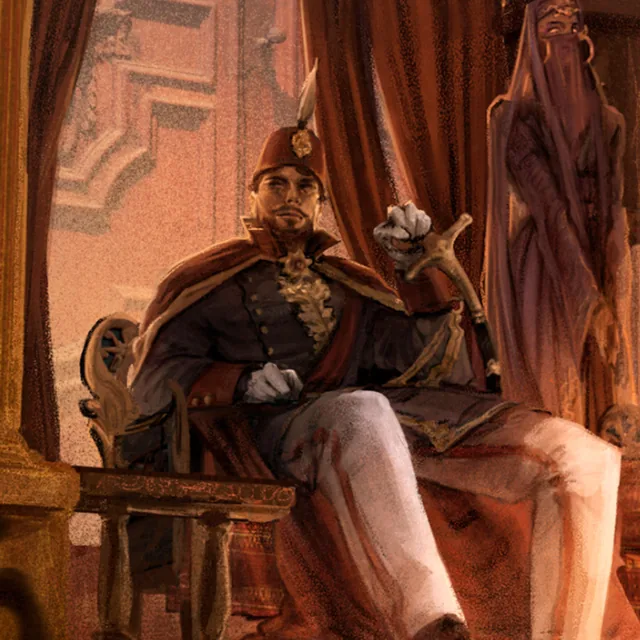
Padishah Abd-ul Mejid, crown prince of the Ottoman Empire, is a figure marked by a singular marriage of the traditional and the modern in his dress, of noble bearing and commonly attended by well-appointed, armed guards. As he took his part in the ceremonial parade toward his enthronement as Padişah (the Sultan), he was presented with the Sword of Osman upon the steps of the Hagia Sophia, a potent emblem of his ascent to power. The crowd received him with mixed feeling — some among them voicing their dissent by the flinging of coins, an act invoking the legacy of the janissaries, whose lingering hold upon the public mind put Abd-ul Mejid's guards the more upon their guard.
During the parade Abd-ul Mejid met with Osman Hamdi Bey, a key ally with whom he keeps a relation respectful yet perhaps a little distant. Together they steer the difficult passage of great political transitions, the confirmation of the Caliph's death among them; and Abd-ul Mejid shows foresight enough to seek assistance as the weight of his new responsibilities settles upon him. Aboard the Ejder-i Derya he discoursed of the late calamities that had befallen the ship and of the political climate, betraying a purposeful care for the welfare of the Empire.
Of late Abd-ul Mejid has entered into marriage with the Haseki Sultan Bergüzar Hatun — no strategic alliance struck with another head of state, but a match of a more personal cast, one that binds the affairs of his heart up with those of the Empire. Amid the ceaseless intrigues of the palace, rumours have arisen touching Abd-ul Mejid's possible dealings with magic or with the Undercity, though such claims want proof.
Abd-ul Mejid has a hand, too, in the raising of a new palace, and has extended to Osman and his recommended associates an invitation to a meeting of moment for the political landscape, one that hints at a connexion to Kavalan's Rebellion. The invitation, laden with a hidden thieves' cant, betrays a secretive nature and a tactical temper braced for the conflicts that may come; and he is known besides for a leader with ties to the Sekban and a long practice in the intricate dynamics of the Empire, above all in the tensions with the Janissaries.
Alongside this noble stature there dwells a younger and other aspect of the same lineage. Abd-ul Mejid, known affectionately as Padishah Abd-ul Mejid, is also a youth of some fifteen or sixteen years, at present in training under Alemdar Mustafa Pasha. He shows curiosity and a quickness of notice at his lessons, though his master reproves him for his wanderings of attention; and he is marked for a budding magical gift which, impressive as it is, has drawn criticism for being turned against his own people. Through a shared dream he came by valuable lessons upon the nature of wounds and of enlightenment, taking to himself the wisdom of Rumi, that "a wound is the place where Enlightenment enters you."
In the latest turn of affairs, Abd-ul Mejid is noted for his firm stand against pluralism in governance, asserting the need for a strong and singular voice. He is engaged besides in diplomatic negotiations between the Ottoman Empire and Egypt, presiding over a formal meeting at which he announced the capture of Hamit the Quartz of Damascus, an associate of Kavalan. During the meeting he betrayed both relief and disturbance, a sign of his awareness of deeper troubles within the palace. He witnessed the execution of Hamit at the hand of Kavalan, who slit the man's throat and laid a spell upon him to draw out what he knew — an act that publicly implicated the Topkapi Palace in possible foul play and strained the talks. He marked, too, an unidentified palace official quitting the meeting in haste, which argued the presence of a mole or fellow-conspirator within the palace. In his complex duality — at once a noble figure and an emerging young man — he heralds a future charged with influence and power amid the turbulent politics of the Empire.